
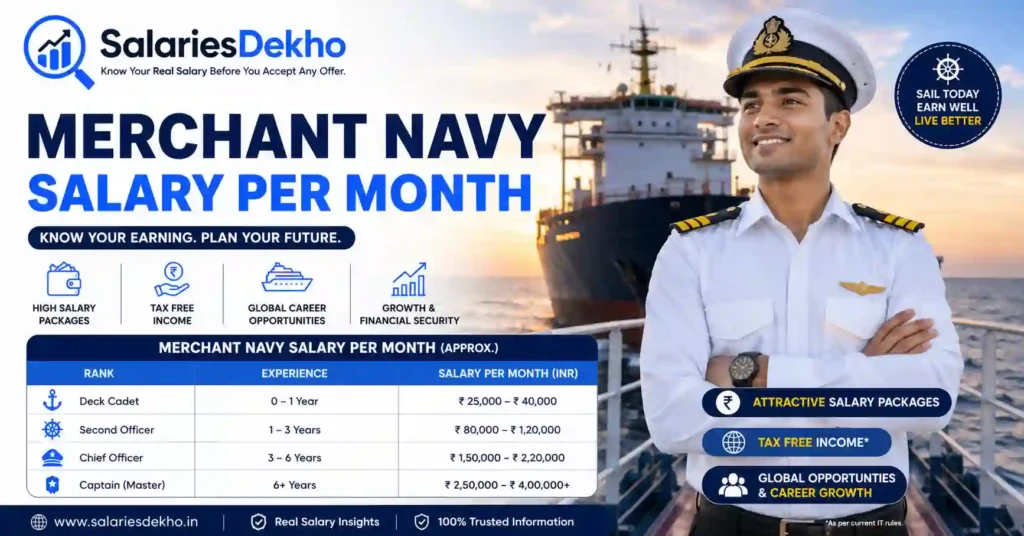
The merchant navy is one of the few careers where a teenager fresh out of school can be earning in dollars within two years, saving almost every rupee of it, and commanding a multi-million-dollar ship before forty. The pay climbs fast, the money is often tax-free, and life on board costs nothing. But the sea asks for a lot in return, and the honest picture is more than just the headline figure. Now most of people ask “what is Merchant Navy salary per month” let’s find out.
This guide breaks down the merchant navy salary per month the way it is actually earned: rank by rank across both the deck and engine departments, in India and worldwide, with the ship types that pay a premium, the tax rule that lets seafarers keep it all, what training really costs here versus abroad, the qualifications you need to start, and the risks and future of the job that most salary pages quietly skip.
Merchant Navy Salary Per Month at a Glance: The Quick Numbers
For the headline before the detail, here is the short version for current pay cycles. Figures are indicative total monthly earnings, frequently tax-free for Indian seafarers who qualify as non-residents by sailing on foreign ships.
| Stage | Monthly (indicative) | What drives it |
|---|---|---|
| Trainee cadet or rating | Rs 25,000 to Rs 85,000 | Stipend during sea training |
| Junior officer | Rs 1,50,000 to Rs 3,00,000 | First Certificate of Competency cleared |
| Senior officer | Rs 5,00,000 to Rs 8,00,000 | Chief Officer or Second Engineer grade |
| Captain or Chief Engineer | Rs 8,00,000 to Rs 20,00,000+ | Command rank, ship type, company |
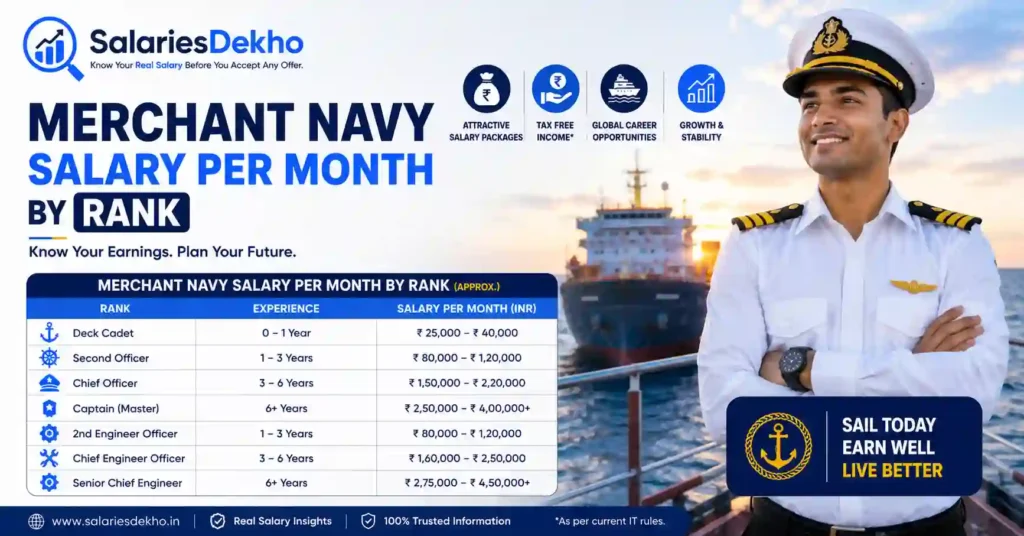
Merchant Navy Salary Per Month by Rank: The Deck and Engine Ladder
A ship runs on two officer streams that climb in parallel. The Deck department navigates and commands, ending at Captain. The Engine department runs the machinery, ending at Chief Engineer. Both ladders pay closely at each matching rung, and each promotion depends on sea time plus clearing a Certificate of Competency exam.
| Career tier | Deck rank | Engine rank | Indicative monthly |
|---|---|---|---|
| Entry / trainee | Deck Cadet | Trainee Marine Engineer | Rs 25,000 to Rs 85,000 |
| Junior officer | Third Officer | Fourth Engineer | Rs 1,50,000 to Rs 3,00,000 |
| Mid officer | Second Officer | Third Engineer | Rs 2,50,000 to Rs 4,50,000 |
| Senior officer | Chief Officer | Second Engineer | Rs 5,00,000 to Rs 8,00,000 |
| Top command | Captain (Master) | Chief Engineer | Rs 8,00,000 to Rs 20,00,000+ |
Two other roles sit alongside these. General Purpose (GP) Ratings, the non-officer crew, earn about Rs 25,000 to Rs 60,000 a month. The Electro-Technical Officer (ETO), who manages the ship’s electrical and automation systems, sits in the mid-officer band and is increasingly well paid as ships get more digital.
What Qualifications the Merchant Navy Demands:
Entry is regulated by the Directorate General of Shipping, and the gateway for most officer courses is the IMU CET entrance exam. The core requirement is 10+2 with Physics, Chemistry and Maths at around 60 percent, plus full medical fitness including 6/6 eyesight, and an age between roughly 17 and 25. Here are the main routes in.
| Course | Duration | Eligibility | Leads to |
|---|---|---|---|
| GP Rating | 6 months | 10th or 12th pass, 40% English | Deck or engine rating |
| Diploma in Nautical Science | 1 year | 10+2 PCM 60%, IMU CET | Deck Cadet |
| B.Sc Nautical Science | 3 years | 10+2 PCM 60%, IMU CET | Deck officer track |
| B.Tech Marine Engineering | 4 years | 10+2 PCM 60%, IMU CET | Engine officer track |
| Graduate Marine Engineering | 1 year | Mechanical engineering degree | Engine officer track |
| ETO course | 4 to 6 months | Electrical or electronics degree | Electro-Technical Officer |
Merchant Navy Salary Per Month Worldwide: The Dollar Advantage
The real magic of the merchant navy salary per month is currency. Foreign shipping companies pay in US dollars, benchmarked against International Transport Workers’ Federation wage guidelines, so the same rank earns far more once converted to rupees. Here is the global officer scale, roughly, with an approximate rupee equivalent.
| Rank | Monthly (USD) | Approx INR |
|---|---|---|
| Deck / Engine Cadet | $400 to $600 | Rs 35,000 to Rs 52,000 |
| Third Officer / Fourth Engineer | $2,400 to $4,500 | Rs 2 to 3.9 lakh |
| Second Officer / Third Engineer | $4,300 to $5,300 | Rs 3.7 to 4.6 lakh |
| Chief Officer / Second Engineer | $6,000 to $9,000 | Rs 5.2 to 7.7 lakh |
| Captain / Chief Engineer | $9,000 to $15,000+ | Rs 7.7 to 13 lakh+ |
On the most technical ships, the ceiling is even higher. Captains and Chief Engineers on LNG and LPG tankers can approach $19,000 a month, putting them in a pay league of their own among seafarers.
How Ship Type Changes the Pay: Tankers, LNG and Beyond
Two officers of the same rank can earn very differently depending on what they sail. Risk, technical complexity and demand all push the pay up, which is why the vessel on your contract matters as much as your stripes.
| Vessel type | Pay level | Why |
|---|---|---|
| Container / bulk carrier | Standard | Steady schedules, common entry point |
| Oil / chemical tanker | Higher | Risk and strict safety rules add a premium |
| LNG / LPG carrier | Highest | Technical complexity, top captain pay near $19,000 |
| Offshore / DP / FPSO | High plus day rates | Specialist skills, $200 to $300 per day |
| Cruise ship | Moderate | Lifestyle perks offset a more regulated pay scale |
Incentives and Perks That Multiply the Package:
The basic figure understates the real value, because so much of a seafarer’s compensation is either tax-free, paid in dollars or delivered as zero-cost living. Here is what stacks on top of the base pay.
| Incentive | How it works | Impact |
|---|---|---|
| Tax-free income | No tax for qualifying non-resident seafarers | The single biggest boost |
| Free food and accommodation | Living costs are zero while on board | Most of the salary becomes savings |
| Paid leave | Long leave roughly matching sea time | Effectively paid time ashore |
| Dollar-denominated pay | Salaries paid in USD on foreign ships | Strong rupee conversion premium |
| Hazard and hardship pay | Extra for high-risk routes and zones | Around $200 a day in piracy areas |
| Specialist premiums | LNG, DP and green-fuel certifications | Adds recurring pay and consultancy scope |
| Retention and performance bonuses | Company incentives to keep officers | Can add 20 to 30 percent |
The Tax Advantage: How Seafarers Keep It All
This is the quiet reason merchant navy pay punches so far above its weight. An Indian seafarer who spends 183 days or more outside India in a financial year, earning on a foreign-going ship, qualifies as a non-resident and pays zero income tax on that foreign income. Gross becomes net.
| Where | Take-home reality | The catch |
|---|---|---|
| Indian seafarer, foreign ship | Tax-free if outside India 183+ days | Must track days carefully each year |
| Indian seafarer, Indian coastal ship | Taxed as normal income | No non-resident benefit |
| Western officer | Higher gross, but taxed at home | Net take-home narrows sharply |
Compared with a Western officer of the same rank, an Indian officer’s dollar salary, kept whole and tax-free, often beats a bigger but taxed Western package on real spendable income. The catch is discipline: the days out of India must be counted precisely, and the income must genuinely be earned for service on a foreign vessel.
The Real Cost of Becoming a Seafarer: India vs Abroad
Before the dollars arrive comes the training bill, and here the merchant navy has a real advantage over careers like aviation. Because Indian DG Shipping and IMU courses are already globally recognised through the STCW convention, most Indian seafarers train at home and still sail worldwide. The cost depends entirely on the route chosen.
| Pathway | Duration | India cost | Notes |
|---|---|---|---|
| GP Rating | 6 months | Rs 1 to 3 lakh | Fastest, ratings entry |
| Diploma in Nautical Science | 1 year | Rs 1.5 to 8 lakh | Deck cadet, sponsorship route |
| B.Sc Nautical Science | 3 years | Rs 2 to 12 lakh | Deck officer degree |
| B.Tech Marine Engineering | 4 years | Rs 9 to 19 lakh | Engine officer degree |
| Graduate Marine Engineering | 1 year | Rs 8 to 12 lakh | Fast engine entry for graduates |
Training abroad, at maritime academies in the UK, Australia or the United States, typically runs two to four times higher once tuition and living costs are added. The important difference from other professions is that it is rarely necessary: Indian companies recruit almost entirely from DG Shipping approved institutes, and the Indian certificate is accepted globally, so the cheaper home route carries no career penalty.
The Evolution of Merchant Navy Salary: From Colonial Crews to Dollar Earners
The pay story of Indian seafarers is a genuine rags-to-riches arc. For much of the colonial era, Indian crews, then known as lascars, worked the engine rooms and decks of foreign ships for a small fraction of what European crews earned for identical work. It was hard, hot, dangerous labour at the bottom of the wage ladder.
Independence, the growth of Indian shipping and the creation of the Directorate General of Shipping slowly professionalised the trade, standardising training and certification. The decisive shift came with globalisation and the spread of International Transport Workers’ Federation wage benchmarking, which pulled Indian officer pay toward international parity regardless of nationality. Combined with dollar salaries and the non-resident tax exemption, seafaring turned into one of the highest-paying careers a student can enter straight after school.
| Era | What defined it | Pay reality |
|---|---|---|
| Colonial era | Indian lascars as low-paid ratings | A fraction of European crew pay |
| 1947 to 1980s | Indian shipping and DG Shipping grow | Professional training, modest pay |
| 1990s to 2010s | Globalisation, ITF wage benchmarking | Pay moves toward global parity |
| 2020s onward | Officer shortage, dollar and tax-free pay | Among the top post-school careers |
The Future of the Job: Automation, Green Ships and a Global Shortage
The strongest force shaping future pay is a shortage. Around ninety percent of the world’s goods still move by sea, the fleet keeps growing, and experienced officers are retiring faster than new ones arrive. Industry bodies have forecast a shortfall running into the tens of thousands of officers, with demand outstripping supply, which keeps upward pressure on salaries.
The obvious worry is automation. Autonomous and semi-autonomous ships are moving from trials to limited service, and green fuels like ammonia, hydrogen and methanol are reshaping engine rooms. But the honest reading is reassuring for seafarers: even the world’s first autonomous cargo ship still sails with crew on board for safety, the international rulebook keeps humans in oversight, and studies conclude there is no shortage of seafarer jobs in the foreseeable future. What changes is the skill mix. Demand is shifting toward engineers, Electro-Technical Officers and tech-literate crew, and away from routine manual roles, so the officers who upskill will ride the wave rather than be swept by it.
The Risks Behind the Paycheck: What the Brochures Skip
The money is real, but so is the cost of earning it. A fair look at the risks matters as much as the salary table.
| Risk | What it means |
|---|---|
| Long time away from home | Contracts of six to nine months at a stretch, with real isolation and mental strain |
| Piracy and conflict zones | Danger on routes like the Gulf of Guinea and Red Sea, hazard pay notwithstanding |
| Physical danger and accidents | Heavy machinery, enclosed spaces and storms, with human error behind most losses |
| Medical dependency | The career hinges on passing recurring medicals, and losing one can end it |
| Thin shore-transfer options | Few well-paid land jobs after sailing, so exit routes are limited |
| Contract, not permanent | Pay stops between contracts, so income is per voyage rather than steady |
Honest Pros and Cons: The Part the Glamour Hides
| Pros | Cons |
|---|---|
| Very high, often tax-free earnings early in life | Months away from family on every contract |
| Zero living costs, so most pay is saved | Isolation and mental strain at sea |
| Global travel and dollar salaries | Real physical danger and safety pressure |
| Fast promotion to command in under a decade | Career depends on staying medically fit |
| Strong, structural demand for officers | Limited well-paid options once you stop sailing |
Frequently Asked Questions: Merchant Navy Salary Per Month
A trainee Deck Cadet or Marine Engineer earns a stipend of about Rs 25,000 to Rs 85,000 a month during sea training. Once the first Certificate of Competency is cleared, a junior officer jumps to roughly Rs 1.5 lakh to Rs 3 lakh a month.
A Captain or Chief Engineer can earn Rs 8 lakh to Rs 20 lakh a month or more. On LNG and LPG tankers, the very top packages approach $19,000 a month, largely tax-free for qualifying non-resident seafarers.
It can be. An Indian seafarer who stays outside India for 183 days or more in a financial year, earning on a foreign-going ship, qualifies as a non-resident and pays zero income tax on that income.
For officer courses, 10+2 with Physics, Chemistry and Maths at around 60 percent, a pass in the IMU CET entrance exam, an age of about 17 to 25, and full medical fitness including 6/6 eyesight. Ratings can enter after 10th or 12th with 40 percent in English.
It ranges widely by route: about Rs 1 to 3 lakh for a GP Rating, Rs 1.5 to 8 lakh for a Diploma in Nautical Science, Rs 2 to 12 lakh for a B.Sc Nautical Science, and Rs 9 to 19 lakh for a B.Tech in Marine Engineering.
Usually yes. Foreign companies pay in US dollars benchmarked to global wage guidelines, so the same rank earns more after conversion. Indian companies can offer more stability and familiarity with local rules.
Typically around eight to twelve years of sea time and cleared competency exams from cadet to command, depending on performance, sea-time availability and ship type.
For the foreseeable future, yes. Autonomous ships still sail with crew for safety, humans stay in oversight, and the officer shortage means demand remains strong. The skill mix is shifting toward engineering and electro-technical roles.
Long stretches away from home, isolation, piracy and conflict-zone danger, physical hazards on board, dependence on staying medically fit, and limited well-paid options after you stop sailing.
Yes. Women serve across deck, engine and electro-technical roles, and shipping companies are actively widening intake. Pay is set by rank and ship, not gender.
Trivia: Things Most People Do Not Know
- Around ninety percent of the world’s goods move by sea, which is why trained seafarers are always in demand.
- India is one of the largest suppliers of merchant navy officers in the world, with tens of thousands sailing across the globe.
- LNG and LPG tanker captains are the top earners at sea, with packages that can approach $19,000 a month.
- Food, accommodation, internet and travel are free on board, so a large share of the salary becomes pure savings.
- Even Norway’s Yara Birkeland, billed as the world’s first autonomous cargo ship, still sails with a small crew on board for safety.
- During the pandemic, some seafarers were stranded at sea for as long as twenty months when ports refused crew changes.
- Pay is usually quoted and paid in US dollars, so a rupee-earning cadet becomes a dollar-earning officer within a couple of years.
The Final Port of Call: What the Numbers Really Say
Strip away the ocean romance and the honest picture is this. The merchant navy salary per month starts modest as a cadet, then rises faster than almost any career a school-leaver can enter, carried by dollar pay, zero living costs and a tax exemption most professions can only envy. A captain on an LNG tanker earns in a month what many earn in half a year ashore.
But every voyage has two sides of the horizon. The paycheck is the reward for months at sea, away from home, in a demanding and sometimes dangerous world. Those who accept that trade, keep their certificates sharp and choose their ships well, sail into an income and a life that few land-based careers can match. The sea pays generously. It simply asks that you show up for the whole voyage.
Also, Read: SBI PO Salary | Loco Pilot Salary | SSC MTS Salary | Agniveer Salary